Is There Really Such A Thing as "Good Form"?
Most of us grow up believing there's a correct way to move.
The right way to squat.
The right way to deadlift.
The right way to bend over.
The right way to sit.
The right way to lift a box off the floor.
And if something hurts while we're doing it, it's easy to assume our form must be wrong.
So we try to copy whatever we think "perfect" movement looks like.
But human movement doesn't always work that way.
Movement Isn't One-Size-Fits-All
No two people move exactly the same.
We're built differently.
We have different proportions.
Different strengths.
Different mobility.
Different injury histories.
Different goals.
It wouldn't make much sense for all of those people to move in exactly the same way.
Instead, our bodies develop different movement strategies to accomplish the same task.
A movement strategy is simply the way your body chooses to perform a movement.
There Is More Than One Way to Move Well
Think about everyday life.
Two people can pick up the same grocery bag using slightly different techniques.
One person may naturally bend more through their hips.
Another may use more knee bend.
Someone else may keep the object closer to their body.
They're all accomplishing the same task.
The same idea applies in the gym.
Whether you're squatting, deadlifting, pressing overhead, or lunging, there are often multiple ways to perform those movements effectively.
One strategy isn't automatically better than another.
The best strategy depends on the individual and what their body is prepared to handle.
Why "Good Form" Can Be Misleading
When people hear they have "bad form," they often assume they need to learn one perfect technique.
In reality, movement is much more adaptable than that.
Sometimes a movement feels uncomfortable not because it's objectively wrong, but because your body is relying heavily on one strategy that places more demand on a particular area.
Imagine two people performing the same exercise.
Both look technically sound.
One finishes without discomfort.
The other develops knee pain halfway through.
The movement isn't necessarily the problem.
The way each person's body is distributing the workload may be completely different.
That's why two people can perform the same exercise and have very different experiences.
Pain Doesn't Always Mean the Movement Is Wrong
One of the biggest shifts we try to help people make is changing how they think about pain.
Pain doesn't automatically mean:
"Never do this movement again."
Often it means:
"The way your body is currently performing this movement isn't working very well."
That's a much more useful problem to solve.
Because movement strategies can change.
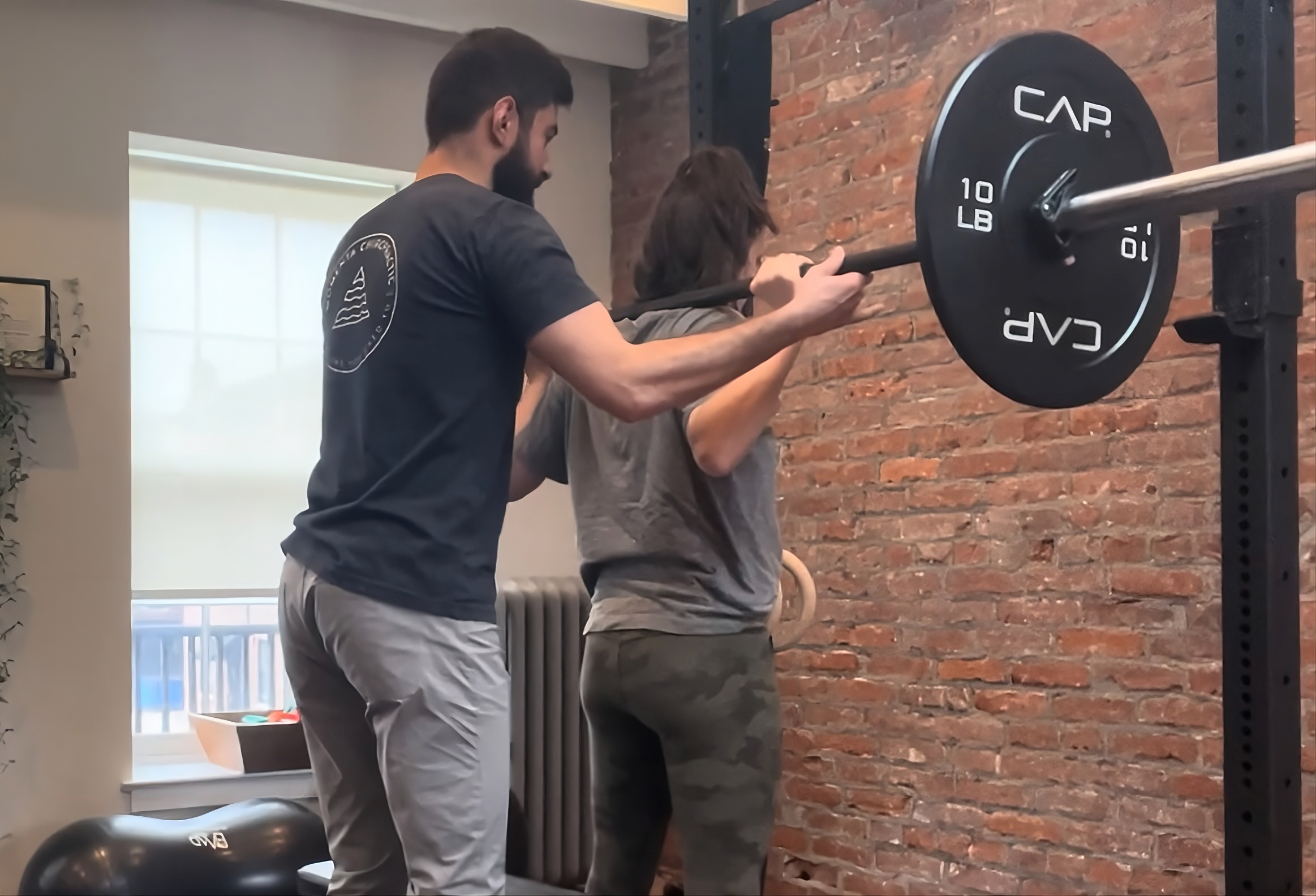
Why We Watch People Move
One of the first things we do at Momenta isn't just ask where something hurts.
We want to understand how you move.
Watching someone bend, squat, reach, rotate, walk, or lift often reveals patterns that symptoms alone can't explain.
Sometimes a particular area is working much harder than it needs to.
Sometimes another joint isn't contributing as much as it could.
Sometimes your body has simply learned one strategy and never developed another.
Those observations help us understand why certain movements feel comfortable while others don't.
The Goal Isn't Perfect Form
Our goal isn't to teach everyone to move exactly the same way.
Our goal is to help people build more movement options.
If one strategy is uncomfortable today, we may be able to find another way to accomplish the same task while we build strength, mobility, and confidence.
Over time, as your body becomes more capable, those options often expand.
Instead of relying on one movement pattern, you develop the ability to adapt.
And that's important because life rarely asks you to move under perfect conditions.
You bend awkwardly to pick up a child.
You reach across the back seat of your car.
You lift a heavy bag of mulch in the garden.
Real life is unpredictable.
Your body should be prepared for that.
Building a More Adaptable Body
One of the biggest goals of rehabilitation isn't simply reducing pain.
It's helping your body become more adaptable.
That means improving your ability to move in different ways without feeling like there's only one "safe" technique.
At Momenta, that's why we spend so much time looking at movement instead of focusing only on symptoms.
We want to understand how your body is solving movement problems today and help you develop more options for tomorrow.
Because confidence doesn't come from memorizing one perfect movement pattern.
It comes from knowing your body can handle the variety that everyday life demands.
Frequently Asked Questions
Is there one correct way to move?
Not usually. While there are general movement principles, most everyday tasks and exercises can be performed using different strategies depending on your body, goals, and current abilities.
What is a movement strategy?
A movement strategy is the way your body performs a specific task. Different people may use different strategies to accomplish the same movement, and those strategies can change over time.
Does pain mean my form is bad?
Not necessarily. Pain may indicate that your current movement strategy is placing more stress on an area than it can comfortably tolerate. That doesn't mean the movement itself is inherently wrong.
Why does Momenta watch people move?
Movement provides information that symptoms alone can't. Watching how someone performs everyday movements helps us understand how different parts of the body work together and what may be contributing to discomfort.
Why is movement variability important?
Life doesn't happen under perfect conditions. Developing multiple movement strategies helps your body adapt to different activities and demands instead of relying on one pattern for every situation.