Why Does Bending Over or Deadlifting Hurt Your Back?
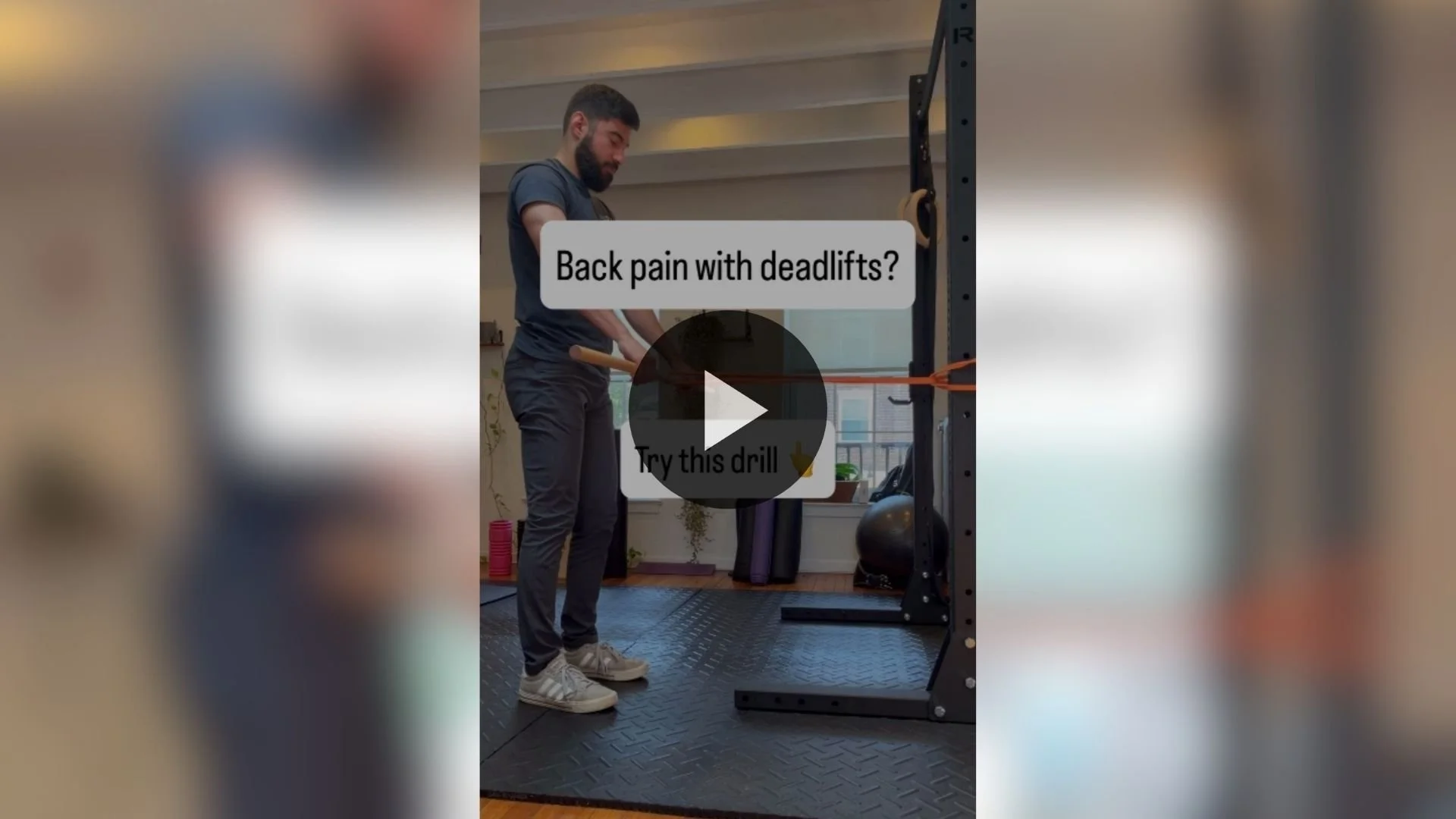
This can be hard to picture just from reading about it, so we put together a short video showing the drill we walk through below.
If bending over to grab something off the floor, loading the dishwasher, or deadlifting at the gym has ever left your lower back sore, it's easy to land on one conclusion: the movement itself must be the problem. So you start avoiding it. You round your knees more than your hips when you pick things up, you skip deadlift day, and maybe you just accept that bending over is "one of those things" that bothers your back now.
Here's a more useful way to think about it. Hip hinging (the motion behind deadlifts, picking things up off the floor, and yes, loading the dishwasher) isn't inherently bad for your back. A lot of people feel pain doing it not because the movement is dangerous, but because of how they're doing it.
It's Often About How You're Hinging, Not the Hinge Itself
A hip hinge is just your body sending your hips backward while your torso leans forward, like a door swinging on a hinge at your hips. It's a completely normal pattern. You use some version of it dozens of times a day.
One pattern we see often: as the hips sit back to stretch the hamstrings, the lower back arches and extends to make up the difference. That extra arch adds extra strain right in the area that's already sensitive. It's not that the hips moved back, it's that the lower back picked up work it wasn't really meant to be doing during that motion.
This isn't true for every single person with back pain during a hinge, and it doesn't mean this is definitely what's happening for you. But it's a pattern worth paying attention to if bending over or deadlifting tends to bring your pain on.
Why the Lower Back Ends Up Doing Extra Work
When the hips and the muscles around them (hamstrings, glutes, core) aren't providing enough control through the hinge, something else usually steps in to stabilize the movement. Often, that's the lower back, arching further than it needs to.
This doesn't mean your hips are "weak" or that you did anything wrong. It usually just means the muscles that are supposed to share the load during a hinge aren't fully in the picture yet, so the lower back covers for them. The goal isn't to stretch harder or push through it. It's to find a way to practice the pattern where the right muscles are doing the stabilizing.
A Different Way to Practice the Hip Hinge
One drill we've been using a lot lately does exactly that. It's a simple banded hip hinge that changes which muscles are responsible for keeping you stable (shown in the video above).
Here's what's happening in the drill: you pull against a band using your lats, the large muscles along your sides that most people associate with pull-ups. Beyond that role, your lats are also a strong stabilizer for your lower back. While keeping tension on the band, you let your hips sit back to feel the hamstring stretch, then bring your hips forward again without letting your lower back arch to make up the difference.
Because the band keeps your lats engaged the whole time, your core and low back get support without your spine having to overextend to find it. You're not trying to sink deeper into the stretch here. You're practicing keeping your spine steady while your hips do the work of the movement.
For a lot of people, that's enough to make hip hinging feel noticeably better. From there, it can become a bridge toward light Romanian deadlifts, and eventually back to regular deadlifts, as confidence and capacity build back up.
Why "Just Stop Bending That Way" Isn't Usually the Answer
There's no single exercise that fixes back pain for everyone, and a hip hinge drill isn't a magic reset button. But avoiding hip hinging altogether tends to create a different problem: it's a movement pattern your daily life depends on, whether or not you ever step foot near a barbell. Groceries, laundry baskets, kids, luggage, the bottom shelf at the grocery store. Working around it forever isn't very practical.
A more useful goal is usually finding a strategy that lets you keep hinging, just without your lower back paying the price for it. That's what a drill like this is for: it lets you keep training the pattern your daily life and your goals depend on, while your body relearns how to do it with better support.
When It Might Be Worth Getting a Second Opinion
Occasional soreness after a heavy lift is different from pain that's sticking around, getting worse, or showing up with other symptoms like numbness or tingling. If that's what you're noticing, it's worth having someone take a closer look. Imaging can be a helpful piece of that picture when it's clinically appropriate, but on its own it rarely tells the whole story. Findings usually need to be interpreted alongside how you actually move and what's provoking your symptoms.
Frequently Asked Questions
Is it bad to deadlift if my back hurts?
Not necessarily. Pain during a hinge is often related to how the movement is being performed rather than the movement being unsafe on its own. It's worth looking at your pattern and your overall capacity before deciding to avoid deadlifts altogether.
Why does my lower back arch when I bend over?
This often happens when the hips and hamstrings aren't providing enough stability through the hinge, so the lower back extends further to compensate. It's a pattern, not a life sentence, and it can usually be retrained.
Can I still deadlift with lower back pain?
It depends on what's driving the pain and how it responds to different loads and positions. Some people benefit from scaling back to lighter hinge variations first, like the drill above, before returning to heavier deadlifts.
What exercises help with hip hinge pain?
Drills that change which muscles are stabilizing the movement, like a banded hip hinge using lat engagement, can help some people hinge with less pain. The right exercise depends on what's actually going on for you.
Do I need an X-ray or MRI for back pain from deadlifting?
Not always. Imaging can be useful in certain situations, but for most hinge-related back pain, a closer look at how you're moving tells us more than a picture of your spine alone.
How long does it take to fix a hip hinge pattern?
It varies quite a bit depending on the person, how long the pattern's been in place, and how much capacity needs to be rebuilt. Some people notice a difference within a few sessions of practicing a new strategy; others take longer.
If Deadlifts or Bending Over Have Been Giving You Trouble
If hip hinging, deadlifts, or just picking things up off the floor have been bothering your back, it might be less about the movement and more about the pattern behind it. At Momenta Chiropractic, we work with people around Bryn Mawr, the Main Line, and Philadelphia to figure out what's actually contributing to that kind of pain and build a plan to help you move through it without pain. If you want us to take a look at what's going on for you specifically, reach out and we'll help you figure out where to start.